
Before the Bell Rang
for anyone who has ever had that friend. for every empty seat that was once filled beside you

I was on a trail when it arrived. The way true things arrive when you’re moving, and the world goes quiet — not announced, just suddenly there, walking beside you.
You had texted me from Spain.
Sad news.
And somewhere between the trail and your cobblestones, between your grief and my understanding of it, I realized something I had somehow never stopped long enough to understand before:
We were now each other’s oldest friends.
Not oldest in age — we’ve settled that argument. Oldest in the way that matters. The longest thread. The one that goes all the way back to before either of us was finished becoming ourselves.
I don’t think I had ever understood that clearly, even to myself, until that morning on the trail. And then I thought of you in Spain — on those cobblestones, in that city — and I understood why I needed to write this down.
There is a kind of friendship the world doesn’t have quite the right word for. Not best friend — that’s what you called it at twelve and it was already too small then. Not sister — though sometimes yes, that, underneath everything. Something more like: the person who was there before you knew you needed someone there. The one who arrived without being invited, the way the truest things do. And stayed.
You had that with her. I have it with you. And losing her — I know this loss is different. Not like losing a parent, not like losing a husband.
Some losses feel as though they take every earlier version of yourself with them.
This is losing the person who remembered you before you were who you are now. The witness. The one who held the early drafts.
She had her own version of all of this with you.
I’ve been thinking about something Pierre says near the end of War and Peace — that if certain lives had never crossed, everything that grew from that crossing would simply not exist. Not just memories. Whole worlds. I think that’s what you’re grieving. Not just her. The world that only existed because the two of you were in it together.
So I want to tell you about us. About what I remember. About your mother setting a plate before I’d even taken off my coat, and my mother hoping quietly and stubbornly for something that was never going to happen, and the way all of it — every ridiculous, ordinary, luminous bit of it — turns out to have been everything.
— —
We were in different classrooms, different schools, on the afternoon it happened. We didn’t know each other yet. Mrs. Langberg walked in crying — not the kind of crying a teacher does in front of children when she means to, the other kind, the kind she couldn’t stop — and said school was over. And then: Kennedy has been killed. She would have used the word assassinated, I think, but she didn’t have the strength to explain what it meant.
Somewhere else in the city, you were hearing the same news from another teacher who also didn’t have the words.
It was the last year in our different schools, in different parts of the city, the end of elementary school.
The following year I was assigned the empty seat beside you.
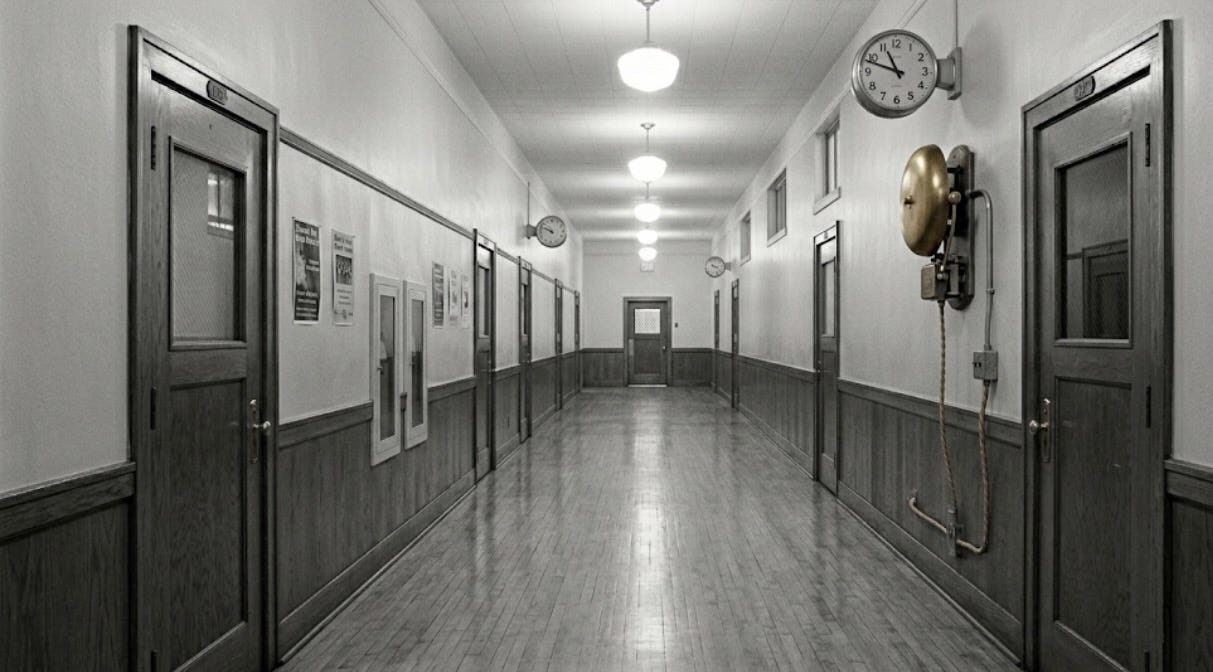
Homeroom. 7SP1. The one fixed point before bells rang and subjects changed, and classrooms shifted and scattered us for the rest of the day. The hallways, quiet.
I remember your frizzy hair before I remember your voice.
You barely noticed me at first.
But that afternoon, we were still strangers, living through the same moments of history without knowing the other existed.
We remember it together now.
You covered your paper during exams. I glanced over anyway. We balanced each other out from the very first day.
What I remember most from those early years isn’t any single moment. It’s the texture of it. The ease. Your mother, who always said, ‘I’ll have him over, I’ll make him a roast beef’ — and meant it every time, and did it. Your dad, always smiling, always welcoming, even after a long day. Your son and grandson have his smile. My father, the way his face changed when you walked into a room — that particular smile, the one he saved. My mother, who loved you with a specific and slightly misguided hope that had everything to do with how clearly she recognized you were good.
There was a bowl on your mom’s kitchen counter. Peanuts and raisins, mixed together, which made no sense to me as a child. I asked her once why they were in the same bowl. She looked at me the way she looked at things that seemed obvious to her and said: because one is salty and one is sweet. One is dry and one is soft. They’re different, and that’s exactly why they belong together. That’s what makes it right.
I didn’t understand what she meant. I was twelve. I thought she was talking about peanuts and raisins.
It took me sixty years to realize she may not have been talking about peanuts and raisins at all.
They’re all gone now, those people. Every one of them. And there is a particular ache in that — not just grief for them individually, but for the whole world they made around us without knowing that’s what they were doing. They just knew it was worth showing up for.
That particular knowing goes with the person who held it.
Unless someone writes it down.
— —
The years moved the way years do — slowly inside them, impossibly fast when you turn around. And through all of it the thread held. Not always taut — there were years of distance, years of our own separate lives pulling us in separate directions — but it held. It was always there to pick back up, exactly where we’d left it, as if time had been polite enough to wait.
We built lives. Marriage. Children. Our individual miracles and heartbreaks. Your life, alongside mine, alongside hers, alongside all of theirs — a web so quietly extraordinary that you stop seeing it until the day a thread goes missing and the whole thing shudders.
And then there was Spain.
You had lived there together as young friends — two women on cobblestones, a life that belonged entirely to that time, wide open and unhurried. I visited in 1974. I remember it clearly: a large goblet filled with fruit and wine, the three of us, three straws. That was the moment. That was Spain.
Fifty years later, you went back. Not with her this time — she stayed behind, and you carried her there the way you carry someone who can no longer make the journey. You walked those streets with her memory beside you, which is its own kind of companionship, bittersweet and irreplaceable. You were bringing Spain back to her. You were keeping the thread alive a little longer.
And it was there — on those cobblestones, in that city that remembered her even if it didn’t know her name — that your phone rang with the news that she was gone.
Spain gave her to you once. And Spain is where you learned you would not have her anymore.
I have thought about that so many times. The way life chooses the most sacred ground for the hardest news. As if it knows. As if it wanted the place and the loss to hold each other forever, so neither one would ever be ordinary again.
— —
She came to me through you, the way the best things do — sideways, through that friend. Yours first, and then mine by extension. Not the same. Never the same. But sixty-two years of real.
When I ran into her — and I did, over the decades, the way you run into someone who has been walking the edges of your life for years — it was always the same. The hug that came from somewhere genuine. The smile that said: I know exactly who you are because of who we both love. We were fluent in each other without ever having studied the language. And every time we parted it was the same — send my regards, tell her I’m thinking of her, wouldn’t it be something if we could all — and then life would move on and there was always going to be a next time.
Until there wasn’t.
I grieve her too. Not the way you grieve her — nothing could be that, nothing should try to be that. But I grieve her. Because at this age it no longer matters precisely how the connection was made or how close it ran. After sixty-two years it simply was. She was woven in. And each loss at this age is both personal and historical at once — you are not only losing the person, you are losing a witness to a time that exists nowhere else now. Every goodbye echoes all the goodbyes. That is the intersection of aging and history, and there is no form to fill out for it, no category that quite covers it. You just carry it.
She and I knew different versions of you across the years, and together we held the long shape of your story.
And now I am the one remaining.
— —
We have always known each other’s preferences. Not the word as it’s used now — the checkbox, the setting, the data quietly harvested by every platform and search that has learned to call surveillance by a gentler name. I mean the real ones. The small accumulated knowledge that only comes from years of paying attention. The preferences that were never clicked or saved or shared — only held, quietly, by the person who loved you long enough to learn them.
Everything knows our preferences now. Our searches, our choices, our 3am questions we’d never say out loud to another person. But it only knows us separately, in parallel, without ever comparing notes. Knowledge without love.
What we have is the other thing. The kind where knowing someone’s preferences is still, after all this time, an act of love. I’m not sure the girl in the homeroom seat could have imagined a world where that would need protecting. But here we are. And I’d still rather have one person who knows my real preferences than a thousand platforms that think they do.
— —
There was a song we knew when we were young. We sang it the way you sing things at that age — full-throated, without irony, without knowing yet what your life would ask of you. We thought it was about geography. Mountains. Valleys. Rivers too wide to cross.
We didn’t know we were singing a map of the years ahead.
Because that’s what it turned out to be. Not a love song. A friendship song. A promise made before we knew we were making it: that no high would be too high to reach each other, no low too deep to find each other there. We sang the words and we meant them in our bodies before we could have meant them in our minds. And then life came, with all its mountains and all its valleys, and we found out we had told the truth.
All those years. All those thresholds crossed together. The words were in our hearts the whole time, even when we weren’t singing them. Even when we were just two people living our lives, far from each other and close to each other by turns, connected by something that didn’t need tending to survive.
So here is what I know. You are my oldest friend. I am yours. We are each other’s longest thread, each other’s proof, each other’s witness to everything that came before. That doesn’t fill what’s missing. Nothing fills what’s missing. But it is real, and it is ours, and it is — I am quietly certain of this — only the beginning of what’s still to come.
Keep writing your chapters. I’ll hold them. Forever. Or until — well. Whatever.
I’m glad the seat was empty until you arrived.
— for anyone who has ever had that friend:
put this down. call them.

Mark, you are a beautiful writer.🤗
You will always have Spain... Until the whole thing shudders, but what fantastic
threads!
A miracle of memories.